Flash News

"जिबन पर्यन्त शिक्षाका लागि पुस्तकालय (Library for lifelong education)"

Sunday, July 13, 2025

Mastering Learning with the Cornell Notes System: A Complete Guide

In today’s fast-paced academic and professional world, taking effective notes isn’t just a study strategy; it’s a survival skill. Whether you’re a student, a researcher, or a lifelong learner, organizing your thoughts clearly and systematically is the key to understanding and retention. One of the most time-tested and efficient methods for this is the Cornell Notes System.

Originally developed at Cornell University by education professor Walter Pauk in the 1950s, this system is still widely used in schools, colleges, and knowledge-intensive workplaces today.


What is the Cornell Notes System?

The Cornell Notes System is a note-taking format that structures your notes in a logical, review-friendly layout. Rather than writing down everything you hear or read in one continuous stream, Cornell Notes divides the page into three distinct sections:

1. Cue Column (Left Side)

Used for questions, keywords, or prompts. This section helps you engage in active recall, think critically, and review easily.

2. Note-Taking Column (Right Side)

This is where you write the main notes during a lecture, reading, or study session. It includes key points, definitions, diagrams, and examples.

3. Summary Section (Bottom)

At the end of the session, you summarize the entire page in your own words. This reinforces learning and solidifies understanding.


How to Set Up Cornell Notes

Here’s how to create a Cornell Notes page on paper or digitally:

Layout Instructions:

  • Draw a vertical line about 2.5 inches from the left margin (for the Cue Column).
  • Leave a bottom space of about 2 inches (for the Summary).
  • Use the main right-hand space for detailed notes.

Here’s a visual guide:
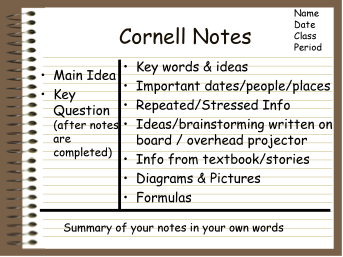
Source: Weebly

 
Step-by-Step: How to Use Cornell Notes

Step 1: Take Notes

During class or reading, use the right column to write down key ideas in bullet points or brief phrases. Don’t try to copy everything—focus on the main points.

Step 2: Write Cues

After class, review your notes and fill in the left column with keywords, questions, or prompts based on the right-side content. These cues guide your self-testing later.

Step 3: Summarize

At the bottom of the page, write a summary (3–5 sentences) of what you learned. This helps with reflection and memory retention.

Step 4: Recite & Review

Cover the right-hand notes. Try to answer the questions or recall the points using only the cues. Then check for accuracy. Repeat regularly for long-term retention.


💡 Why Use the Cornell Notes System?

1. Promotes Active Learning

By forcing you to summarize and reflect, it transforms passive note-taking into active engagement.

2. Enhances Memory & Understanding

The spaced layout aids in organizing information and makes it easier to revisit and review.

3. Supports Critical Thinking

Writing questions and cues helps you evaluate, synthesize, and apply what you learn—beyond rote memorization.

4. Ideal for Exam Prep

Cue-based review makes Cornell Notes an excellent tool for revision and self-quizzing.


Cornell Notes in Practice: A Sample

Cue (Question/Key Idea)

Notes (Main Concepts)

What is Kairos in writing?

Kairos refers to the right timing and context in rhetoric—delivering a message at the most opportune moment.

What is Ethos?

Ethos appeals to credibility. Writers use it to establish authority and trust.

How to paraphrase?

Expressing the same idea using your own words and sentence structure, while retaining meaning.

✍️ Summary:

Cornell Notes help me capture rhetorical concepts clearly and revise efficiently. The structure forces me to reflect and retain core ideas beyond the surface.


Tools to Use Cornell Notes Digitally

You can easily apply the Cornell format using:

  • Notion
  • OneNote
  • Evernote
  • Google Docs
  • Handwritten notebooks or printable

Friday, May 2, 2025

Grammarly: A Smart Writing Assistant for Research Scholars

In the academic and research world, the clarity, accuracy, and credibility of writing are critical. Whether drafting a thesis, preparing a research article, or writing grant proposals, scholars must present their work in a grammatically sound and professionally polished manner. This is where Grammarly, a powerful AI-based writing assistant, becomes a valuable tool for research scholars.

What is Grammarly?

Grammarly is an AI-powered digital writing assistant that helps users write clearly, concisely, and correctly. It offers grammar, spelling, punctuation, style, and tone suggestions in real time. Available as a browser extension, desktop app, Microsoft Word add-in, and mobile app, Grammarly caters to users across platforms.

It has both free and premium versions, with the premium plan offering advanced features ideal for academic and research writing.

How Grammarly Helps Research Scholars

1. Grammar and Punctuation Correction

Academic writing demands high precision in grammar and punctuation. Grammarly identifies and corrects:

  • Subject-verb agreement issues
  • Improper comma placement
  • Run-on sentences
  • Passive voice (with context-based recommendations)

This allows scholars to focus on content rather than proofreading every sentence manually.

2. Clarity and Readability

Research scholars often write complex texts. Grammarly helps simplify language and improve flow by:

  • Suggesting clearer sentence structures
  • Recommending word replacements for clarity
  • Highlighting overly long or convoluted sentences

This ensures the writing is not only correct but also easy to understand, especially for an international audience.

3. Academic Style Suggestions

Grammarly Premium offers formality and tone suggestions, which are critical in academic writing. It:

  • Replaces informal expressions with formal alternatives
  • Identifies hedging language and vague terms
  • Maintains consistency in terminology

This helps ensure that writing aligns with scholarly tone and conventions.

4. Plagiarism Detection

Grammarly Premium includes a plagiarism checker that scans texts against billions of web pages and academic articles. It:

  • Detects unintentional plagiarism
  • Highlights improperly cited content
  • Encourages originality and integrity in research writing

This is especially useful before submitting articles to journals or repositories.

5. Vocabulary Enhancement

Academic writing often requires precise vocabulary. Grammarly:

  • Suggests advanced vocabulary appropriate for scholarly work
  • Helps avoid word repetition
  • Encourages varied sentence structures

Such refinements increase the quality and credibility of the writing.

6. Citations and References (Complementary Tools)

Although Grammarly itself doesn’t manage citations, it integrates well with other tools like Zotero, Mendeley, or EndNote, ensuring that the grammar and style around citations are clean and professional.

Practical Use Cases for Research Scholars

  • Thesis or dissertation writing
  • Research paper and journal article submissions
  • Abstracts and conference presentations
  • Research grant applications and proposals
  • Correspondence with academic supervisors and editors

Limitations to Keep in Mind

While Grammarly is highly effective, it should not replace critical thinking or professional editing. Scholars must still verify technical terms, domain-specific language, and citation accuracy themselves.

Conclusion

Grammarly is a powerful ally for research scholars aiming to write with confidence and professionalism. It streamlines the editing process, enhances clarity, ensures grammatical correctness, and reduces the risk of plagiarism—key requirements for successful academic communication. By integrating Grammarly into their research workflow, scholars can save time, reduce stress, and improve the overall impact of their written work.


The International Federation of Library Associations and Institutions (IFLA): Championing Libraries Worldwide

The International Federation of Library Associations and Institutions (IFLA) stands as the global voice of the library and information profession. Established in 1927, IFLA has grown into a vibrant international organization, shaping the future of libraries, promoting equitable access to information, and fostering professional collaboration across borders. With its deep-rooted history, broad divisions, strategic goals, and global activities, IFLA is instrumental in transforming libraries to meet the challenges of the 21st century. Nepal Library Association (NLA) is the member of IFLA, representing Nepal to the global network. 

History

Founded in Edinburgh, Scotland, during the International Congress of Libraries, IFLA began as a small federation of library associations in Europe. Over the decades, it has evolved into a truly international body with more than 1,500 members from over 150 countries. Its headquarters are located at the National Library of the Netherlands in The Hague. IFLA has continually expanded its scope to represent all types of libraries—academic, public, national, and special—and has taken a strong role in international advocacy and policy development.

Divisions

IFLA is structured into Divisions that organize its vast network of sections and interest groups. These divisions reflect professional areas and ensure inclusive representation. The main divisions include:

  • Division I: Library Types – Covers public, national, school, and academic libraries.
  • Division II: Library Services – Focuses on library services to diverse communities.
  • Division III: Collections and Access – Encompasses acquisition, cataloguing, preservation, and access.
  • Division IV: Support of the Profession – Includes education, training, statistics, and research.
  • Division V: Regions – Represents different geographical areas such as Africa, Asia and Oceania, Latin America and the Caribbean, etc.

Strategic Programmes

IFLA operates through Strategic Programmes that align with its IFLA Strategy 2019–2024. The four strategic directions are:

  1. Inspire – Inspire and enhance professional practice.
  2. Engage – Engage effectively in library advocacy.
  3. Connect – Connect global library communities.
  4. Enable – Enable and strengthen the profession.

These directions are supported by flagship initiatives like IFLA's Global Vision, Building Strong Library Associations (BSLA), and Advocacy for the UN Sustainable Development Goals (SDGs).

Committees

The governance and development of IFLA’s work are guided by its Governing Board, supported by various Advisory Committees, Professional Units, and Standing Committees. Key committees include:

  • Professional Council
  • Regional Council
  • Advisory Committee on Freedom of Access to Information and Freedom of Expression (FAIFE)
  • CLM (Copyright and other Legal Matters)
  • PAC (Preservation and Conservation)

These committees ensure informed decision-making and support IFLA’s advocacy and strategic delivery.

Programs and Activities

IFLA conducts numerous programs and activities throughout the year to support its mission:

  • World Library and Information Congress (WLIC) – The flagship annual event bringing together thousands of library professionals globally.
  • Workshops, webinars, and training – Regular professional development programs on emerging issues like open access, digital inclusion, and AI.
  • Advocacy campaigns – Including SDG Stories and International Advocacy Programmes that empower libraries to influence national development policies.

Library Map of the World

The IFLA Library Map of the World (LMW) is a groundbreaking platform that visualizes library data from across the globe. It highlights:

  • The number and types of libraries by country
  • Library staff and users
  • Library services supporting the UN SDGs

This interactive tool supports advocacy by showcasing the global reach and impact of libraries. https://librarymap.ifla.org/

Knowledge Publications: Journals, News, and Announcements

IFLA regularly publishes a wealth of knowledge resources, including:

  • IFLA Journal – A peer-reviewed academic journal covering research and innovation in library science.
  • IFLA Newsletters – Providing updates from divisions, sections, and the Secretariat.
  • IFLA Blogs and Statements – Addressing urgent global issues like copyright reform, digital access, and AI.
  • IFLA Repository – A digital archive of all policy documents, presentations, and reports.

These publications serve as vital tools for library professionals, researchers, and policymakers.

Manifestos

IFLA develops and endorses Manifestos in collaboration with UNESCO and other international bodies to promote the roles of libraries in specific contexts. Key manifestos include:

  • UNESCO/IFLA Public Library Manifesto
  • IFLA School Library Manifesto
  • IFLA Multicultural Library Manifesto
  • IFLA Internet Manifesto

These declarations provide guiding principles and advocate for the essential role of libraries in education, cultural preservation, and human rights.

Standards

To ensure consistency, quality, and interoperability, IFLA produces international standards and guidelines. Some of the most influential include:

  • IFLA Cataloguing Principles
  • ISBD (International Standard Bibliographic Description)
  • UNIMARC format
  • Guidelines for Library Services to Persons with Dyslexia
  • Preservation and Conservation Guidelines

These standards are widely adopted by library institutions and integrated into national policies and practices.

Conclusion

IFLA continues to be the cornerstone of global library development, advocating for access to information, cultural heritage preservation, equitable knowledge systems, and the advancement of open science. Its vision for strong libraries at the heart of inclusive societies drives its diverse activities, and through collaboration with members worldwide, IFLA is shaping a future where information truly empowers every individual.

As the digital and social landscape evolves, IFLA remains committed to connecting library professionals, strengthening institutions, and influencing international agendas in favor of a more literate, informed, and equitable world. 

Sunday, March 10, 2024

FOLIO: A Modern Approach to Library Management

FOLIO (Future of Libraries is Open) is an open-source library services platform designed to revolutionize library operations in the digital age. Here's a glimpse into its key features:

Open Source and Community Driven: Unlike traditional, proprietary library systems, FOLIO is open-source, giving libraries greater control and flexibility. The development is driven by a collaborative community of librarians, developers, and vendors, ensuring features cater to actual library needs.

Modern Architecture: FOLIO boasts a cloud-based, microservices architecture. This means the system is built using independent, modular components that can be easily updated and scaled. This ensures flexibility, agility, and continuous innovation.

Unified Print & Electronic Resource Management: FOLIO seamlessly manages both physical and digital library collections. Libraries can catalog books, journals, e-resources, and other materials within a single platform.

Flexibility and Customization: FOLIO is highly configurable. Libraries can tailor the system to their specific workflows and user needs. Additionally, the open-source nature allows for further customization through code modifications.

Integration with Third-Party Apps: FOLIO integrates with various third-party library applications, expanding its functionality. This allows libraries to leverage specialized tools for specific tasks while maintaining a central platform for core library operations.

Open API and Interoperability: FOLIO offers open APIs enabling communication with external systems. This fosters data exchange and integration with other library technologies, creating a more streamlined information environment.

User-friendly Interface: FOLIO prioritizes a user-friendly interface for both librarians and library patrons. The intuitive design simplifies tasks and makes resource management and discovery efficient.

Focus on the Future: FOLIO is constantly evolving, with a strong emphasis on innovation. The community-driven development ensures the platform adapts to meet the changing needs of libraries and users in the digital landscape.

A modern Library Service Platform built by an open community

The platform is the only LSP designed for the cloud, created through the collaboration of libraries, developers, vendors, networks and consortia. Anyone can contribute, and everyone will benefit. Since its inception hundreds of librarians representing libraries of all types, sizes and locales have contributed their subject matter expertise to help define FOLIO functionality. Teams of developers around the globe have contributed design, code, and tests. Providers are delivering implementation, consulting and hosting services. The entire community continues to grow. More and more libraries and vendors are realizing the benefits of this modern, open collaboration.

Modern architecture

Modern means being designed for the cloud: multi-tenant, API-driven, app-based, modular, technically flexible and open. FOLIO checks all of these boxes. Designed from the outset to be multi-tenant, app based. API-first system, the platform provides a modular architecture which is extensible (reference the platform being used to create a resource sharing product). The modular architecture drives separation of business logic from implementation details allowing modules to leverage different technologies as are appropriate, or to include new technologies when they become available..

An LSP built for choice

Functionally flexible, FOLIO allows apps to be created that satisfy different combinations of library workflows and the community expects to have the luxury of choice between apps when configuring their deployment. There are multiple apps that can be used to manage the content in your Inventory, for example. Developers can choose specific technologies to leverage, or how to piece functionality together within an App. Vendors can choose which services to deliver. Libraries have the choice of how to host FOLIO – they can host it themselves, or choose one of the hosting providers in the community. Not only can they choose who will host their FOLIO, they can choose to have one vendor host part of their FOLIO solution and another vendor (or themselves) host other part(s). And of course when contracts expire those choices will resurface.

The future of libraries is open

While FOLIO is rich in community roots and interests, at its heart the FOLIO project was created to provide a service to Libraries. This open, modern, flexible, extendible, powerful platform that helps libraries solve needs of today, also provides leverage for the future. It allows libraries the choices and options needed to control their technical platforms into the future. FOLIO is open – truly open ensuring that control will remain in tact.

Nothing else provides this combination of traits. FOLIO is unique.

In summary, FOLIO offers a powerful, flexible, and future-proof library management solution. It empowers libraries to streamline operations, enhance resource discovery, and provide a more user-centric library experience. Foliodocs

Saturday, March 9, 2024

Useful tools for supporting research

In the current digital era, researchers may now gather and analyse data more easily and effectively because to the abundance of tools at their disposal. These research instruments produce more accurate and trustworthy outcomes while also saving time. We'll look at a few of the fundamental research instruments that every investigator needs to have in their toolbox in this blog article.

This blog will cover every aspect, from data gathering to data analysis and presentation. So, if you're a researcher trying to maximise productivity and enhance output, continue reading to learn about the essential resources for successful research.

In order to properly gather, evaluate, and distribute information, research needs a variety of instruments. Search engines like Google Scholar, JSTOR, and PubMed, as well as reference management software, are some crucial research tools.

1. Google Scholar – Google Scholar is a search engine for scholarly literature, including articles, theses, books, and conference papers.

2. JSTOR – JSTOR is a digital library of academic journals, books, and primary sources.

3.PubMed – PubMed is a free search engine accessing primarily the MEDLINE database of references and abstracts on life sciences and biomedical topics. 

4. Web of Science: A comprehensive citation index that allows you to search for articles, conference proceedings, and books across various scientific disciplines. It’s valuable for tracking citations and identifying influential research.

5. Scopus – Scopus citation database that covers scientific, technical, medical, and social sciences literature. 

6. Zotero: Zotero is a free, open-source citation management tool that helps you organize your research sources, create bibliographies, and collaborate with others.

7. Mendeley – Mendeley is a reference management software that allows you to organize and share your research papers and collaborate with others.

8. EndNote – EndNoted is a software tool for managing bibliographies, citations, and references on the Windows and macOS operating systems. 

9. RefWorks – RefWorks is a web-based reference management tool that allows you to create and organize a personal database of references and generate citations and bibliographies.

10. Evernote – Evernote is a digital notebook that allows you to capture and organize your research notes, web clippings, and documents.

11. SPSS – SPSS is a statistical software package used for data analysis, data mining, and forecasting.

12. R – R is a free, open-source software environment for statistical computing and graphics.

13. Stata – Stata is a statistical software package that provides a suite of applications for data management and statistical analysis.

14. Excel – Excel is spreadsheet software used for organizing, analyzing, and presenting data.

15. Tableau – Tableau is a data visualization software that allows you to create interactive visualizations and dashboards.

16. NVivo – Nviva is a software tool for qualitative research and data analysis.

17. Slack – Slack is a messaging platform for team communication and collaboration.

18. Zoom – Zoom is a video conferencing software that allows you to conduct virtual meetings and webinars.

19. Microsoft Teams – Microsoft Teams is a collaboration platform that allows you to chat, share files, and collaborate with your team.

20. Qualtrics – Qualtrics is an online survey platform that allows researchers to design and distribute surveys, collect and analyze data, and generate reports.

SubjectPlus Software: Enhancing Library Management and Services

Libraries have evolved significantly over the years, transitioning from traditional paper-based systems to digital platforms. In this digital age, efficient library management software plays a crucial role in streamlining operations, improving user experience, and enhancing overall service delivery. One such powerful tool is SubjectPlus, which offers a range of benefits for libraries and their patrons.

What Is SubjectPlus?

SubjectsPlus is a user-friendly, open source, content management system for information sharing. SubjectsPlus provides tools to create information-rich subject guides, organize curated content for specific audiences in or around a research topic, and to develop and manage library websites. SubjectsPlus offers you a robust toolbox: use it as your library’s home page, create a quick reference FAQ list, maintain dynamic staff and database lists, add suggestion or catalog search boxes – SubjectsPlus offers this and more. 

SubjectsPlus gives library staff an easy-to-use interface for creating web content without  web design experience. It also offers flexible options for advanced users to include theming and  functionality via SubjectPlus’ add-on widgets. As an open source product, SubjectsPlus is flexible, customizable, and more affordable than proprietary alternatives. Let’s delve into the advantages of using SubjectPlus:

1. User-Friendly Interface

SubjectPlus provides an easy-to-use interface that allows library staff to create web content without requiring specialized web design skills. Librarians can develop subject guides, organize curated content, and build informative pages—all within a straightforward framework. The software’s simplicity ensures that even non-technical users can contribute effectively.

2. 24/7 Access to Resources

In the digital realm, accessibility is paramount. SubjectPlus ensures that library resources are available round the clock. Students, researchers, and library managers can access materials, including videos, books, journals, eBooks, and photos, seamlessly through a single platform. This accessibility eliminates frustration and enhances the overall user experience.

3. Reduced Manual Labor

Gone are the days of manual record-keeping. SubjectPlus maintains a comprehensive daily record of issued, returned, available, and unreturned books. Librarians can manage critical library activities with just a few clicks. This automation significantly reduces the need for labor-intensive tasks, allowing staff to focus on more strategic aspects of library management.

4. Reliable Data Management

SubjectPlus is highly reliable, secure, and scalable. Libraries can confidently record and manage data related to their book collections. The risk of errors or data loss is minimized, ensuring the integrity of the library’s information.

5. Time Savings

Librarians can issue or reissue books swiftly without compromising accurate record-keeping. Students can check the availability of specific books through the software, saving time and effort. The streamlined process benefits both library staff and users.

6. Automated Reporting

SubjectPlus generates detailed reports, graphs, and charts, maximizing library performance. Librarians can track activities, monitor updates, and assess historical data. The software’s reporting capabilities facilitate evidence-based decision-making.

7. Innovative Features

Advanced versions of SubjectPlus offer innovative features. Students can engage in topic research, upload videos and photos, and participate in discussion forums. Connecting with librarians through chat features enhances collaboration and knowledge sharing.

8. Customization and Theming

SubjectPlus allows for customization and theming. Libraries can tailor the software to match their branding and create a cohesive online presence. Advanced users can explore add-on widgets to enhance functionality further.

You can successfully complete installation without any knowledge of MySQL, but if you do have some knowledge you can make additional changes to the look and feel of the SubjectsPlus interface. In addition, the subject guides can be created by librarians with no technical knowledge, since much of the operation is via WYSIWYG (What You See Is What You Get) editors. Subject librarians can therefore truly 'own' their subject domain and use SubjectsPlus to 'market' the most interesting items available to ensure maximal usage of the e-resources they have available.

In conclusion, SubjectPlus revolutionizes library management by providing a user-friendly, efficient, and comprehensive solution. As libraries continue to adapt to digital landscapes, embracing tools like SubjectPlus ensures that they remain relevant, accessible, and valuable to their communities.

Remember, the future of libraries lies in their ability to seamlessly integrate technology, and SubjectPlus is a step in the right direction.

Friday, March 8, 2024

Library 5.0

Library 5.0 is a future vision of libraries that are community-centric, highly digitized, and intelligent. It focuses on using emerging technologies like big data analytics, the Internet of Things, and artificial intelligence to personalize user experiences and enhance community engagement. It also emphasizes the importance of libraries evolving into learning and innovation centers that support creativity, entrepreneurship, and lifelong learning.

Library 5.0 is a forward-looking vision for libraries that emphasizes community-centric, highly digitized, and intelligent services. Here are the key aspects:

Community-Centric: Library 5.0 places the community at its core. It aims to understand and cater to the unique needs of library users, fostering a sense of belonging and active participation.

Highly Digitized: In Library 5.0, digital technologies play a pivotal role. Libraries leverage emerging tools such as big data analytics, the Internet of Things (IoT), and artificial intelligence (AI) to enhance services and user experiences.

Virtual reality (VR) and augmented reality (AR): Libraries 5.0 may use VR and AR to create immersive learning experiences. For example, a library could use VR to transport users to a historical event or to the surface of Mars.

Personalization: Library 5.0 focuses on tailoring services to individual preferences. By analyzing data, libraries can recommend relevant resources, events, and programs to each user.

Enhanced Community Engagement: Through digital platforms, Library 5.0 fosters interaction, collaboration, and knowledge sharing among community members. It encourages active participation beyond physical library spaces.

Evolution from Library 1.0 to Library 5.0: The concept of Library 5.0 builds upon earlier library models:

Library 1.0: Traditional libraries with physical collections and limited technology.

Library 2.0: Introduced interactive features, user-generated content, and social media integration.

Library 3.0: Focused on semantic web technologies, personalized services, and context-awareness.

Library 4.0: Embraced emerging technologies like virtual reality, augmented reality, and blockchain.

Library 5.0: Envisions a holistic, community-driven digital ecosystem.

Library 5.0 is still a concept, but some libraries are already beginning to implement some of its features. For example, some libraries are using big data analytics to track user behavior and preferences. Others are using AI to provide chat reference services. As technology continues to develop, we can expect to see even more libraries adopting the features of Library 5.0.

Benefits of IOT in Library Services

The internet of things (IOT) is a network of interrelated devices that connect and exchange data with other IoT devices and the cloud. IoT devices are typically embedded with technology such as sensors and software and can include mechanical and digital machines and consumer objects.

Increasingly, organizations in a variety of industries are using IoT to operate more efficiently, deliver enhanced customer service, improve decision-making and increase the value of the business.

With IoT, data is transferable over a network without requiring human-to-human or human-to-computer interactions.

A thing in the internet of things can be a person with a heart monitor implant, a farm animal with a biochip transponder, an automobile that has built-in sensors to alert the driver when tire pressure is low, or any other natural or man-made object that can be assigned an Internet Protocol address and is able to transfer data over a network.

The Internet of Things (IoT) can bring a bundle of advantages to libraries, making them smarter and more user-friendly. Here's a look at how:

Let’s explore the benefits of Internet of Things (IoT) in library services, with a focus on user-friendliness:           


 1. Enhanced User Experiences:

Seamless Access to Resources: IoT devices can facilitate smoother access to library resources. For instance, smart sensors can guide users to available books or study areas, reducing search time.

Optimized Physical Environment: IoT-enabled climate control systems adjust temperature and lighting based on occupancy, creating a comfortable and conducive environment for users.

Safety and Security: IoT devices enhance security by monitoring entrances, exits, and sensitive areas. They can detect anomalies and trigger alerts, ensuring user safety.

2. Efficient Inventory Management:

IoT sensors can track book movements, monitor shelf occupancy, and automate inventory checks. This streamlines library operations, allowing staff to focus on more valuable tasks.

3. Personalized Services:

By analyzing user behavior and preferences, IoT can tailor recommendations. For example, it can suggest relevant books based on a user’s reading history or interests.

4. Space Utilization Optimization:

IoT data helps libraries optimize space allocation. Real-time occupancy tracking ensures efficient utilization of study rooms, seating areas, and meeting spaces.

5. Energy Efficiency:

Smart lighting and HVAC systems reduce energy wastage. Lights automatically turn off when areas are unoccupied, contributing to sustainability.

6. Maintenance and Predictive Analytics:

IoT devices monitor equipment health. Predictive maintenance alerts staff before issues escalate, preventing disruptions and extending the lifespan of library assets. 

IoT transforms libraries into dynamic and responsive spaces, enhancing user experiences while improving operational efficiency. 

Use of AI in Library and Information Services

Artificial Intelligence (AI) is making significant strides and rapidly transforming the way libraries and information services operate.AI enhancing various aspects of library operations and services. Let’s delve into how AI is transforming libraries:

1.    Information Retrieval and Search Enhancement:

-AI technologies improve search functionality within library catalogs and databases.

-DynaMed and Micromedex with Watson and Expert.ai are examples of AI-powered search tools integrated into library systems

-These tools enhance the accuracy and relevance of search results, making it easier for patrons to find the information they need.

2.    Personalized Recommendations:

-AI algorithms analyze user behavior and preferences to provide personalized recommendations.

-Libraries can use AI to suggest relevant books, articles, or resources based on a patron’s past interactions.

-This tailored approach enhances the user experience and encourages exploration.

3.    Resource Management Optimization:

-AI assists in optimizing resource allocation, ensuring that libraries efficiently allocate budgets, staff, and physical space.

-Predictive analytics help libraries anticipate demand for specific materials, leading to better collection management.

4.    Enhanced User Experience:

-Chatbots powered by AI provide instant assistance to library users, answering common queries and guiding them through services.

-AI-driven virtual assistants enhance user engagement and accessibility.

5.    Data-Driven Decision-Making:

-AI analyzes data on library usage, circulation patterns, and user preferences.

-Insights from this data inform decisions related to acquisitions, services, and outreach.

6.    Collaboration and Knowledge Sharing:

-AI facilitates collaboration among libraries by recommending relevant research articles, connecting researchers, and identifying potential partnerships.

-It fosters knowledge sharing within the library community.

In summary, AI is revolutionizing library services, making them more efficient, user-friendly, and responsive to patrons’ needs. Libraries play a crucial role in educating users about AI and its implications, ensuring responsible and ethical adoption

Saturday, June 5, 2021

Educational learning objectives: Bloom's Taxonomy

Bloom’s taxonomy is a set of three hierarchical models used to classify educational learning objectives into levels of complexity and specificity. The models organize learning objectives into three different domains: Cognitive, Affective, and Sensory/Psychomotor.  

Bloom’s taxonomy was developed to promote higher forms of thinking in education, such as analyzing and evaluating concepts, processes, procedures, and principles, rather than simply memorizing facts.

Learning objectives can be viewed in behavioral terms. As instructional designers collaborate with subject matter experts (SMEs) to develop courses, they can see what students are capable of as a direct result of the instruction they have received at each level.

Using the categorization, courses can be designed with appropriate content and instruction to lead learners up the pyramid of learning. Instructional designers can also design valid assessment tools (i.e., quizzes) to ensure each category is met and in turn, that each part of the course material is in line with the level’s objectives. However, oftentimes, especially in a corporate setting, several of the stages are interconnected and blend into each other.

Learners may not be aware of Bloom’s taxonomy, but to them, it serves to bridge the gap between what they know now, and what they need to learn in order to attain a higher level of knowledge—and perform better at their jobs.

The purpose of applying Bloom’s taxonomy is to create measurable goals—perfect for corporate learning and development. If applied successfully, the learner has acquired a new skill or level of domain expertise and instructional designers are able to effectively assess this learning on an ongoing basis as the course moves through each stage of the framework.


IFLA/UNESCO School Library Manifesto

The School Library in Teaching and Learning for All

The school library provides information and ideas that are fundamental to functioning successfully in today's information and knowledge-based society. The school library equips students with life-long learning skills and develops the imagination, enabling them to live as responsible citizens.

The Mission of the School Library

The school library offers learning services, books and resources that enable all members of the school community to become critical thinkers and effective users of information in all formats and media. School Libraries link to the wider library and information network in accord with the principles in the UNESCO Public Library Manifesto.

The library staff support the use of books and other information sources, ranging from the fictional to the documentary, from print to electronic, both on-site and remote. The materials complement and enrich textbooks, teaching materials and methodologies.

It has been demonstrated that, when librarians and teachers work together, students achieve higher levels of literacy, reading, learning, problem-solving and information and communication technology skills.

School library services must be provided equally to all members of the school community, regardless of age, race, gender, religion, nationality, language, professional or social status. Specific services and materials must be provided for those who are unable to use mainstream library services and materials.

Access to services and collections should be based on the United Nations Universal Declaration of Human Rights and Freedoms, and should not be subject to any form of ideological, political or religious censorship, or to commercial pressures.

Funding legislation and networks

The school library is essential to every long-term strategy for literacy, education, information provision and economic, social and cultural development. As the responsibility of local, regional and national authorities, it must be supported by specific legislation and policies. School Libraries must have adequate and sustained funding for trained staff, materials, technologies and facilities. They must be free of charge.

The school library is an essential partner in the local, regional and national library and information network.

Where the school library shares facilities and/or resources with another type of library, such as a public library, the unique aims of the school library must be acknowledged and maintained.

Goals of the school library

The school library is integral to the educational process.

The following are essential to the development of literacy, information literacy, teaching, learning and culture and are core school library services:

  • supporting and enhancing educational goals as outlined in the school's mission and curriculum;
  • developing and sustaining in children the habit and enjoyment of reading and learning, and the use of libraries throughout their lives;
  • offering opportunities for experiences in creating and using information for knowledge, understanding, imagination and enjoyment;
  • supporting all students in learning and practising skills for evaluating and using information, regardless of form, format or medium, including sensitivity to the modes of communication within the community;
  • providing access to local, regional, national and global resources and opportunities that expose learners to diverse ideas, experiences and opinions;
  • organizing activities that encourage cultural and social awareness and sensitivity;
  • working with students, teachers, administrators and parents to achieve the mission of the school;
  • proclaiming the concept that intellectual freedom and access to information are essential to effective and responsible citizenship and participation in a democracy;
  • promoting reading and the resources and services of the school library to the whole school community and beyond.

The school library fulfils these functions by developing policies and services, selecting and acquiring resources, providing physical and intellectual access to appropriate sources of information, providing instructional facilities, and employing trained staff.

Staff

The school librarian is the professionally qualified staff member responsible for planning and managing the school library, supported by as adequate staffing as possible, working together with all members of the school community, and liaising with the public library and others.

The role of school librarians will vary according to the budget and the curriculum and teaching methodology of the schools, within the national legal and financial framework. Within specific contexts, there are general areas of knowledge that are vital if school librarians are to develop and operate effective school library services: resource, library, and information management and teaching.

In an increasingly networked environment, school librarians must be competent in planning and teaching different information-handling skills to both teachers and students. Therefore they must continue their professional training and development.

Operation and Management

To ensure effective and accountable operations:

the policy on school library services must be formulated to define goals, priorities and services in relation to the school's curriculum;

the school library must be organized and maintained according to professional standards;

services must be accessible to all members of the school community and operate within the context of the local community;

co-operation with teachers, senior school management, administrators, parents, other librarians and information professionals, and community groups must be encouraged.

Implementing the Manifesto

Governments, through their ministries responsible for education, are urged to develop strategies, policies and plans which implement the principles of this Manifesto. Plans should include the dissemination of the Manifesto to initial and continuing training programmes for librarians and teachers.

*IFLA/UNESCO - School Library Manifesto 1999

*IFLA, School Library Manifesto 2021

IFLA/UNESCO Public Library Manifesto 1994

Freedom, prosperity and the development of society and of individuals are fundamental human values. They will only be attained through the ability of well-informed citizens to exercise their democratic rights and to play an active role in society. Constructive participation and the development of democracy depend on satisfactory education as well as on free and unlimited access to knowledge, thought, culture and information.

The public library, the local gateway to knowledge, provides a basic condition for lifelong learning, independent decision- making and cultural development of the individual and social groups.

This Manifesto proclaims UNESCO's belief in the public library as a living force for education, culture and information, and as an essential agent for the fostering of peace and spiritual welfare through the minds of men and women.

UNESCO therefore encourages national and local governments to support and actively engage in the development of public libraries.

The Public Library

The public library is the local centre of information, making all kinds of knowledge and information readily available to its users.

The services of the public library are provided on the basis of equality of access for all, regardless of age, race, sex, religion, nationality, language or social status. Specific services and materials must be provided for those users who cannot, for whatever reason, use the regular services and materials, for example linguistic minorities, people with disabilities or people in hospital or prison.

All age groups must find material relevant to their needs. Collections and services have to include all types of appropriate media and modern technologies as well as traditional materials. High quality and relevance to local needs and conditions are fundamental. Material must reflect current trends and the evolution of society, as well as the memory of human endeavour and imagination.

Collections and services should not be subject to any form of ideological, political or religious censorship, nor commercial pressures.

Missions of the Public Library

The following key missions which relate to information, literacy, education and culture should be at the core of public library services:

  • creating and strengthening reading habits in children from an early age;
  • supporting both individual and self conducted education as well as formal education at all levels;
  • providing opportunities for personal creative development;
  • stimulating the imagination and creativity of children and young people;
  • promoting awareness of cultural heritage, appreciation of the arts, scientific achievements and innovations;
  • providing access to cultural expressions of all performing arts;
  • fostering inter-cultural dialogue and favouring cultural diversity;
  • supporting the oral tradition;
  • ensuring access for citizens to all sorts of community information;
  • providing adequate information services to local enterprises, associations and interest groups;
  • facilitating the development of information and computer literacy skills;
  • supporting and participating in literacy activities and programmes for all age groups, and initiating such activities if necessary.

      Funding, legislation and networks

The public library shall in principle be free of charge.

The public library shall in principle be free of charge. The public library is the responsibility of local and national authorities. It must be supported by specific legislation and financed by national and local governments. It has to be an essential component of any long-term strategy for culture, information provision, literacy and education.

To ensure nationwide library coordination and cooperation, legislation and strategic plans must also define and promote a national library network based on agreed standards of service.

The public library network must be designed in relation to national, regional, research and special libraries as well as libraries in schools, colleges and universities.

Operation and management

A clear policy must be formulated, defining objectives, priorities and services in relation to the local community needs. The public library has to be organized effectively and professional standards of operation must be maintained.

Cooperation with relevant partners - for example, user groups and other professionals at local, regional, national as well as international level- has to be ensured.

Services have to be physically accessible to all members of the community. This requires well situated library buildings, good reading and study facilities, as well as relevant technologies and sufficient opening hours convenient to the users. It equally implies outreach services for those unable to visit the library.

The library services must be adapted to the different needs of communities in rural and urban areas.

The librarian is an active intermediary between users and resources. Professional and continuing education of the librarian is indispensable to ensure adequate services.

Outreach and user education programmes have to be provided to help users benefit from all the resources.

Implementing the Manifesto

Decision makers at national and local levels and the library community at large, around the world, are hereby urged to implement the principles expressed in this Manifesto.

The Manifesto is prepared in cooperation with the International Federation of Library Associations and Institutions (IFLA).

~ifla dot org

How to face changes in life: Who moved my Cheese?

Who moved my Cheese? Published in 1999 by Dr. Spencer Johnson. Emphasizing on change and the human psyche to respond to daily changes in life, this book indicate some key facts to follow if one has to grow in their life instead of getting stuck in a moment of repent or sorrow for whatever strange is currently happening and already happened in life.

Change is the only thing which is constant and it will going to happen in your life whether you like it or not. It’s better to be ready for that rather than getting an unexpected surprise in life /work.

The story is about four characters in this book, two mice and two little individuals who live in a maze and are searching for the cheese which they think satisfies them. Here Cheese is a similitude for the things which you need in your life and fulfills us like a monetary achievement, a relationship, opportunity, wellbeing, acknowledgment, and maze is where you are looking for these things. It may be in any way similar to Organization, people group in which you live or the relationship you have in your life.

Key lessons which can be inferred out of this story are given as follows:

  • If you do not change, you can become extinct? : Keep updating yourself with the changes around you.
  • What would you do if you were not afraid? : It is ok to be afraid but should not be afraid of taking risks in your life when it is necessary.
  • Smell the cheese often, so you know when it is getting old? : Be alert and aware of your surroundings. Keep checking for any change in your cheese and prepare yourself accordingly.
  • When you move beyond fear, you feel free : Let go of your fear, Stay Focused and positive then only you will be able to give your 100%.
  • Imagining myself enjoying new cheese even before I find it leads me to it : Follow the Universal law of attraction. Keep thinking of what you want and you will get it.
  • The quicker you let go of old cheese, the sooner you find new cheese : Don’t hold on to things in your life. Let yourself flow like a river and draw new paths (New cheese) when change happens.
  • It is safer to search in the maze, than remain in a cheese-less situation: Don't cry about what you have lost. See what is still there. Where there is a will there is a way.
  • Old belief does not lead you to new cheese: Keep experimenting with different ways in order to get new cheese. New inputs will lead to new outputs.
  • When you see that you can find and enjoy new cheese, you change course: Try to instill this belief in yourself that you can get your cheese and having it will make you happy.
  • Noticing small changes early helps, you adapt to the bigger changes that are to come: Be observant in life.
  • What you are afraid of is never as bad as what you imagine. The fear you let build up in your mind is worse than the situation that actually exists: Thinking about losing will never let you win. Conquer your fears.
  • Move with the cheese: Life doesn't stop and neither should you.
x

Thanks!